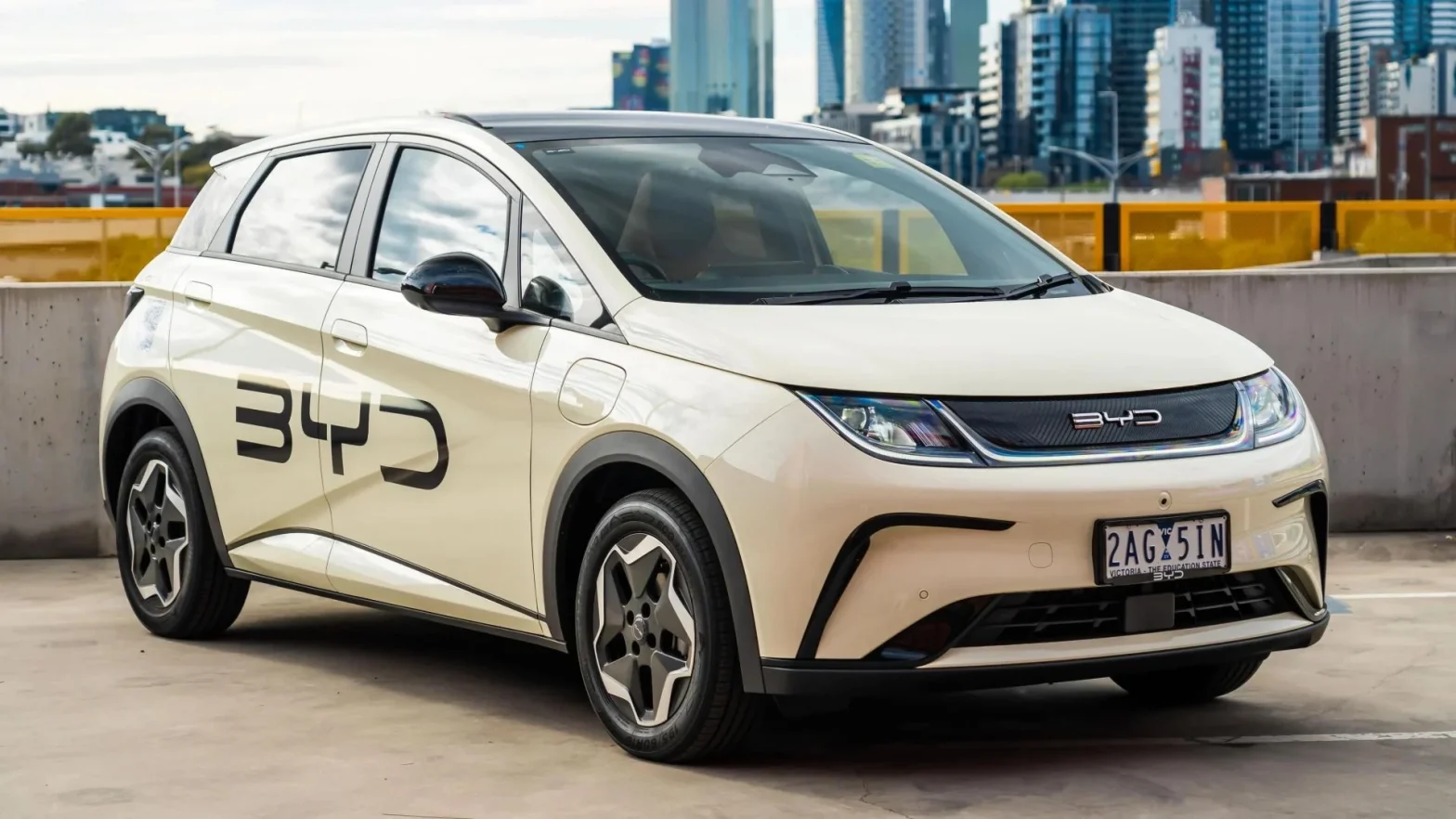
Think of the 2025 BYD Dolphin as the automotive equivalent of a flat‑white with oat milk: familiar in size, unexpectedly smooth, and friendlier to the planet than yesterday’s long‑black commuter. The Chinese‑built hatch has sailed into Australian showrooms at under thirty grand, offering a real‑world WLTP range of up to 427 km and a punchy 0‑100 km/h time of 7.0 seconds in Premium guise. In a market that once demanded luxury‑car money for an electric runabout, the Dolphin replaces sticker shock with raised eyebrows and curious grins.
Pros and Cons
Pros: bargain entry price, long standard‑equipment list, Blade Battery with V2L, roomy rear seat for a light hatch.
Cons: steering lacks feel at highway speed, Essential’s smaller motor feels breathless on steep grades, no spare wheel, still limited rural service network. These quibbles matter, yet none are deal‑breakers at the Dolphin’s price.
How Much Does It Cost?
BYD sharpened the pencil for 2025. The new Essential opens at $29,990 plus on‑roads, making it Australia’s first sub‑$30,000 EV. Step up to Premium and you are still only at $36,990 before charges. For context, the cheapest MG 4 currently lists at $39,990, while the entry Hyundai Kona Electric hovers near $55,000. BYD is plainly gunning for buyers who would otherwise be cross‑shopping petrol Corollas.
Features and Benefits
Even the base Essential gets a 12.8‑inch rotating touchscreen, wireless smartphone mirroring, a heat‑pump, vehicle‑to‑load capability and a full suite of driver aids. The Premium adds a bigger 60.5 kWh Blade Battery, a 150 kW front motor, heated vegan‑leather seats and a panoramic glass roof. Cabin plastics will not be mistaken for premium European fare, yet the playful colour blocking and dolphin‑fin dash trim lift the mood. The boot swallows 345 litres, which is enough for a week’s groceries plus a pram when you fold the split floor panel.
Safety
ANCAP awarded the Dolphin a full five stars under the tough 2023 protocol, praising occupant protection and active collision‑avoidance tech. Standard kit includes front, side, curtain and front‑centre airbags, adaptive cruise, lane‑keep assist and rear cross‑traffic alert. Only a middling chest score in the driver’s side‑impact test prevents a class‑leading result.
Running Costs
Blade Battery chemistry (lithium‑iron‑phosphate) tolerates daily 100 percent charging without fuss, so owners can safely top up at home off‑peak for roughly $6 to $7 per 100 km at current national electricity averages. Scheduled servicing is annual or 20,000 km; the first five visits average under $300 each, lower than most petrol hatchbacks. Battery warranty runs eight years or 160,000 km, and BYD’s over‑the‑air updates have already trimmed energy use since launch.
Comparison To Its Competitors
Against the MG 4 Excite, the 2025 BYD Dolphin loses rear‑wheel‑drive playfulness yet claws back cabin space and throws in V2L. Compared with a GWM Ora, the Dolphin is quicker, offers longer range and undercuts it on price. The Nissan Leaf E+ still asks almost $16,000 more while delivering shorter range and no fast rotating screen. In short, the Dolphin’s combination of keen pricing, 2025 BYD Dolphin features, and a genuinely usable 2025 BYD Dolphin range rewrites the light‑EV rulebook.
Conclusion
The 2025 BYD Dolphin electric car is not perfect, but perfection was never the brief. BYD has built a small hatch that feels honest, practical, and cheekily good value. It makes electric urban motoring normal, which is arguably the most disruptive thing any new model can do right now.
Rating: 8.5/10
With a blend of affordability, impressive 2025 BYD Dolphin performance, a cleverly packaged interior, and industry-shaking value, the Dolphin makes a strong case in its segment. Eliminate the slight steering numbness and expand regional servicing, and it could set an even higher benchmark.