
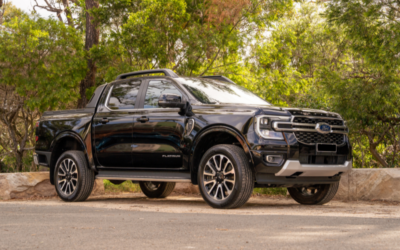
It says a lot about how the Australian car buying scene has evolved that utes are the top-sellers. It’s less surprising that the Ford Ranger is the most popular. That’s because the blue oval has a lot of followers in Australia and this latest generation Ranger is a very good vehicle. As a 4×4 dual cab – which is what we’re focused on here – it fulfills the complex and sometimes conflicting roles of work, family and play vehicle better than any of its rivals. In part that’s due to its local engineering and development, but also the high quality gear that goes under its typically boxy and upright ute look.
In Short:
- Remains Australia’s top dual-cab 4×4 pick thanks to excellent on-road comfort, local tuning, strong towing and handles work, family and weekend trips easily.
- Wide range of models and features with strong engines, especially the V6, plus lots of modern tech and safety.
- Cabin quality sets the segment benchmark, though back seats are not as roomy as some competitors.
- Biggest downside is ongoing reliability concerns compared with rivals like HiLux, plus higher pricing at the top end.
Our Ford Ranger Car Rating:
The 2025 Ford Ranger earns a strong 8/10 as one of the best all-round dual-cab you can buy in 2025.
Pros and Cons
Pros:
- The best driving ute in Australia, off-road and on-road
- Can tow 3500kg and haul a tonne – or close to it
- Smart, quality interior
Cons:
- The diesel engines are impressive to drive, but have reliability questions
- Not the best off-roader in the segment
- PHEV is a great ute but not much of an EV
Features and Benefits
Pricing and Equipment
You could spend this entire review just breaking down and describing the extended line-up of Australia’s top-selling vehicle.
But we’re going to make it simpler by just focussing on the popular dual cab 4×4 models.
If you’re looking for a ute as a family transporter and recreational vehicle as well as a work platform then this is where you’ll be shopping.
Even then it takes a bit of getting your head around with XL, XLS, XLT, Sport, Wildtrak and Platinum permanent grades (special editions come and go). Ford previously offered three diesel engine options – single and biturbo-diesel 2.0-litre four-cylinder and 3.0-litre V6 turbo-diesel – but that has been culled to two with the discontinuation of the 2.0-litre biturbo.
There are also two 4×4 systems, including a part-time set-up for more affordable four-cylinders and a full-time system for the V6.
Then there’s the four most recent arrivals, the petrol-electric PHEV line-up of XLT, Sport, Wildtrak and Stormtrak.
Pricing starts at $51,130 for the lowliest XL and climbs all the way to the $90,690 for the crazy Raptor super-ute, which is such a different proposition we’re leaving it out of this review.
The equipment walk is obviously diverse, starting with the XL’s steel wheels, halogen headlights and cloth seats and progressing all the way to Platinum’s matrix LED headlights, leather accents and 20-inch alloys.
All models get digital instrument panels and infotainment touchscreens (there are two sizes), wireless Apple CarPlay and Android Auto, manual air-con or dual-zone climate control and the FordPass smartphone app. Power seating kicks in with the Sport.
The key rivals for the Ranger are the Toyota HiLux, Isuzu D-Max/BT-50 non-identical twins, new Kia Tasman and the Mitsubishi Triton. The plug-in hybrid BYD Shark 6 is a recent interloper.
Drive Away in a Ford Ranger
We’ll search, compare, and haggle so you don’t have to. We’ll find the best deal on your next Ford Ranger with zero stress.
Warranty and Servicing
The Ford Ranger is covered by a full five year/unlimited km warranty, even if it is used for commercial purposes (some ute warranties make that distinction).
The PHEV adds eight years/160,000km protection for its high-voltage battery.
Ford also provides up to seven years roadside assist if you service through blue oval dealers.
Service intervals are 12 months/15,000km and each of the first four visits to the dealer workshop are currently capped at $379 for the diesel and $399 for the PHEV.
Safety Ratings and Equipment
The Ford Ranger diesel line-up is covered by a five-star ANCAP rating based on 2022 protocols. This has since been superseded, but it’s still relevant.
The rating does not apply to the PHEV Rangers.
One very good thing about Ranger is the democratisation of high-end safety equipment across the line-up. At a minimum autonomous emergency braking, adaptive cruise control, lane keeping assist, reverse brake assist, blind spot monitoring and traffic sign monitoring are standard.
There are nine airbags and at least a reversing camera and reversing sensors. Step up through the grades and more sophisticated lane centring, speed monitoring, a 360-degree camera and front parking sensors all added.
There are dual outboard child seat top tethers and ISOFX mounts in the rear seat.
Space, Comfort and Quality
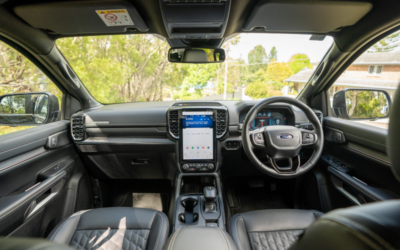
When it launched in 2022 the Ford Ranger undoubtedly set a new standard for cabin design and comfort in the ute segment.
Only now are the likes of the Kia Tasman and BYD Shark 6 getting into the same league.
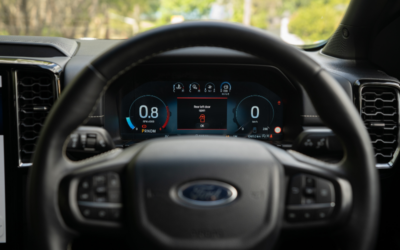
Those big screens certainly make the tech statement in the Ranger. Ford’s worked to ease the pain of drilling into the infotainment screen with favourites buttons that really help.
Sadly, though most models come with a pretty unimpressive instrument panel Only the Platinum (and Raptor) get a bigger and clearer readout.
Front seat passengers are accommodated in large seats and are surrounded with generous storage. The driver benefits from a reach and rake adjustable steering and a large pedal box with left footrest.
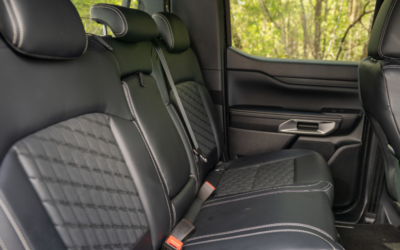
In the rear, passengers don’t get as much space as some rivals such as the BYD Shark 6 and the new oversized Foton Tunland ute. But versatility is great with a folding backrest and a base that can be raised to reveal storage underneath.
The Thai-built Ranger is a solid vehicle and the various examples we have tested in rugged conditions through the years have hung together well. The higher up the range you go the more premium the feel and presentation gets.
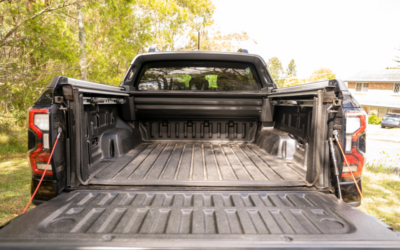
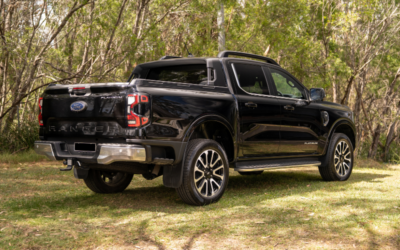
The load box is sizeable enough to fit an Aussie pallet between the wheel arches and the most work-focussed models can carry over a tonne. The PHEVs are a bit down because of their significant kerb weight, but even the Stormtrak claims over 800kg.
Powertrain and Dynamics
Its rivals are getting closer, but the Ford Ranger 4×4 dual cab remains at the top of the tree when it comes to driving quality in the 4×4 dual cab segment.
There’s nothing radical here, it just works on Aussie roads, something that reflects its local engineering and development by Ford.
One of the big advantages for the Ranger is the 3.0-litre V6 engine that tops all other diesels in the segment for smoothness and response. It’s not that bad on fuel either, depending on how hard you use it.
The recently discontinued 2.0-litre biturbo (there will still be some in dealerships in early 2026) lacks a little by comparison, but it’s certainly competitive with the four-cylinder diesels most rivals serve up. It’s also that bit more economic than the V6.
In 2026 Ford will detail updates to the single turbo 2.0-litre, which will be spread wider across the range and pick up the 10-speed auto used in other variants.
That auto can get busy shifting cogs in the closely stacked bottom gears, but not annoying. The bit that is annoying is the squat gear selector that only allows manual gear changes via a button on its side. It’s darned awkward.
The PHEV is a smooth and powerful performer as a hybrid, but pretty limited when left in EV mode. Its electric-only range is limited by a small battery (you’ll likely get 30-35km). But the flipside of that is it it’s better work ute than either the Shark 6 or GWM Cannon Alpha. They are the better EVs.
The Ranger’s ride and handling reflects its local tuning. It devours all forms of road surfaces comfortably despite being fitted with leaf springs and a rigid rear axle. It also steers lightly and easily, making it okay for tight twirling in town – if you must drive there in a 5.37m-long vehicle – or on bush tracks.
The Ranger is not the best 4×4 in the class. It needs its rear diff lock engaged sooner than the HiLux and its low-range traction control isn’t as well modulated. But it’s still capable of knocking over just about any sane challenges. You want insanity? Go the Raptor.
The entire Ranger 4×4 dual cab line-up claims a 3500kg braked towing capacity, which helps explain why you see so many in caravan parks!
The V6 is undoubtedly the champ for towing, but the 2.0-litre holds its own. Don’t forget the Ranger Super Duty is on its way with a 4500kg braked towing capacity!
All sounds great doesn’t it? But there is one area the Ranger struggles: reliability. Anecdotal reports suggest a Ranger is more likely to have engine issues than a HiLux.
We’d like to see Ford work harder to ensure the Ranger can spend more time on the road than potentially being relegated to the workshop.
2025 Ford Ranger Verdict
Rivals are closing in but the Ford Ranger remains the pick of the 4×4 dual cabs. It does everything well and some things brilliantly.
It’s not perfect – no vehicle is – and it’s not the most affordable ute on offer. But within this huge line-up most utes buyers are going to find something that suits their needs and wants.
Rating: 8/10
Your Next 4×4 Dual Cab Awaits
Tap into our network of over 2,700 dealerships and find the perfect 4×4 for work, family, and weekend adventures with Motor Scout.
2025 Ford Ranger Dual-cab 4×4 Specifications
Model variants: XL, XLS, XLT, Sport, Wildtrak, Platinum, Stormtrak (PHEV only).
Price: $51,130 to $90,690 plus on-road costs.
Engine/drivetrain options: 2.0-litre four-cylinder turbo-diesel; 3.0-litre V6 turbo-diesel, 2.3-litre four-cylinder turbo-petrol PHEV; 4×4, 10-speed auto.
Power/torque: 125kW/405Nm 2.0-litre four-cylinder turbo-diesel; 154kW/500Nm four-cylinder biturbo-diesel; 184kW/600Nm V6 turbo-diesel; 207kW/597Nm 2.3-litre four-cylinder turbo-petrol PHEV.
Fuel consumption/EV use/EV range: 7.4L/100km 2.0-litre four-cylinder turbo-diesel; 7.2L/100km four-cylinder biturbo-diesel; 8.4L/100km V6 turbo-diesel; 2.9L/100km and 18.7kWh/100km 2.3-litre four-cylinder turbo-petrol PHEV.
Main Rivals
The main rivals to the Ford Ranger, in the 4×4 dual-cab segment for 2025, are:
- Toyota HiLux: long-time segment leader, known for reliability and strong resale value.
- Isuzu D-Max / Mazda BT-50: rugged, work-focused utes with strong diesel engines.
- Mitsubishi Triton: practical and affordable with decent towing and payload.
- Nissan Navara: comfortable ride and good towing, slightly more premium feel.
- Kia Tasman: newer entry, modern features and styling, aimed at family and lifestyle buyers.
- BYD Shark 6: plug-in hybrid option, more tech-focused, limited EV range but strong for work and family use.