
The current generation Hyundai Tucson has been around in Australia since 2021 and has established itself as one of Australia’s most popular medium family-oriented SUVs. Over the last year or so there’s been a substantial update and powertrain simplification. Most recently Hyundai has upgraded to a seven-year warranty from five years (albeit with provisos), which makes the Tucson all the more appealing. But it’s got a tough fight in Australia’s bigger new vehicle segment against some very impressive opposition.
In Short:
- One of Australia’s most popular medium SUVs, now strengthened by a new seven-year warranty and a simplified, more efficient lineup.
- Spacious, high-quality interior with excellent rear-seat room, big boot space and plenty of family-friendly features.
- Strong safety tech across the range, with Premium models adding high-end features like surround-view monitoring.
- Hybrid powertrain is the clear standout, smooth, responsive and impressively economical, while the base 2.0-litre engine is underpowered and thirstier than expected.
- Servicing costs and short 10,000km intervals for the hybrid are drawbacks, and the Tucson’s suspension tuning isn’t as polished as top rivals like the Kia Sportage.
- Best pick of the range is the front-wheel-drive hybrid for performance, efficiency and value.
Our Hyundai Tucson Car Rating:
The 2025 Hyundai Tucson scores a solid 7.5/10 as a practical, safe and family-friendly medium SUV that does most things well, even if it lacks the sparkle and refinement of the class leaders.
Pros and Cons
Pros:
- Spacious and quality interior
- Strong safety equipment line-up
- The hybrid is smooth, responsive and in front-wheel drive form, especially economic
Cons:
- The 2.0-litre engine is cheaper but also a dawdler and quite thirsty
- Hybrid service intervals are a short 10,000km
- Prefer a full-size spare tyre in the hybrid
Features and Benefits
Pricing and Equipment
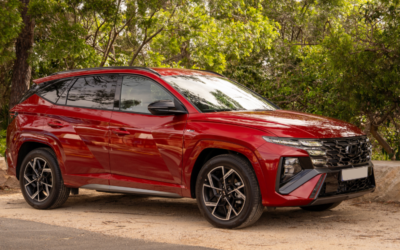
The five-door five-seat Hyundai Tucson medium SUV is offered in three different equipment lines – Tucson, Elite and Premium, with the latter two also available with mainly cosmetic N Line option packs.
There are two powertrains, a 115kW/194Nm 2.0-litre petrol four-cylinder that combines with a six-speed auto to drive the front wheels and a 172kW/367Nm 1.6-litre petrol-electric hybrid that also employs a six-speed auto. It can be had as both a front-driver and all-wheel drive.
Pricing starts at $38,350 plus on-road costs for the cheapest Tucson 2.0 and climbs to $59,850 plus ORCs for the Premium N Line all-wheel drive flagship. The Premium trim is only offered as a hybrid.
If that starting price sounds high for the Tucson then it’s been a while since you’ve been out shopping in this segment. Apart from some cheaper Chinese models, a $40K spend is about where you kick off in this segment now.
Key rivals for the Tucson are the heavy-hitters of the medium SUV segment including the Toyota RAV4, Kia Sportage, Nissan X-Trail, Mazda CX-5 and Honda CR-V.
Those cheaper Chinese include the GWM Haval H6, MG HS and Chery Tiggo 7. They offer plug-in hybrids as well as naturally-aspirated base models, as does the PHEV-exclusive BYD Sealion 6.
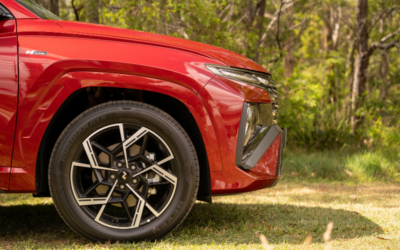
Standard Tucson exterior equipment includes alloy wheels ranging from 17- to 19-inches in size, roof rails, LED headlights and a hands-free powered tailgate for all bar the base model. The Premium alone gets a panoramic sunroof.
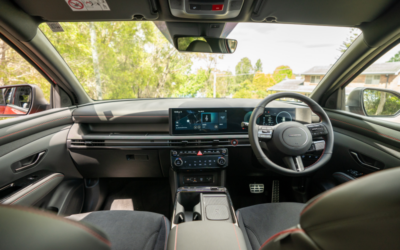
Inside the equipment walk starts with cloth seat trim for the Tucson, but from then on leather makes an appearance. The driver’s seat is powered from Elite onwards. Heated and ventilated seats are also introduced as the entry price climbs.
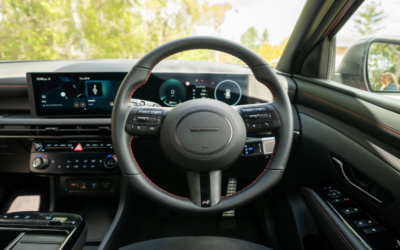
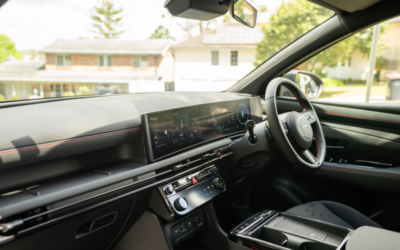
Dual-zone climate control with adjustable rear vents is standard across the range, while only the Tucson base model misses out on the full width digital instrument cluster and infotainment set-up and embedded satellite navigation. However, Apple CarPlay and Android Auto are standard for all models, as is the Hyundai Bluelink smartphone app.
Audio systems are a choice of six-speaker or Bose eight-speaker, which is offered with Tucson Premium. The Premium is also alone in adding a head up display on the windscreen in front of the driver.
Find Your Perfect Hyundai Tucson
We’ll search, compare, and negotiate so you don’t have to. Let us find the best deal on your new Hyundai Tucson, quick, easy, and stress-free.
Warranty and Servicing
The Hyundai Tucson is backed by a new seven-year/unlimited km warranty, conditional on servicing at a dealership. The high voltage battery in the hybrid is protected for eight years/160,000km.
The Tucson is also protected by lifetime roadside assistance – as long as you service with a Hyundai dealer.
Tucson-petrol service-intervals are 12 months/15,000km and a shorter 12 months/10,000km for the hybrid. Intriguingly, the smaller Hyundai Konda Hybrid has 15,000km service intervals.
Capped price servicing is offered for each powertrain.
Safety Ratings and Equipment
The Hyundai Tucson range is protected by a maximum five star ANCAP based on 2021 protocols. Those protocols are now superseded but still a good vote of confidence in this car’s fundamental integrity.
As is the usual Hyundai way, the level of standard driver assist systems is generous. Every models gets autonomous emergency braking, adaptive cruise control, bind spot monitoring and collision avoidance, various forms of lane keeping and parking and reversing collision assist.
Driver monitoring is also included and along with speed limit monitoring is annoying and intrusive and is a bit of a chore to switch off, although Hyundai has made a partially successful attempt to streamline all that with its 2024 update.
Premium has a few exclusives including surround view and blind spot view monitors.
Tucson comes with seven airbags, three child seat top tether mounts in the rear seat and two Isofix mounts.
Space, Comfort and Quality
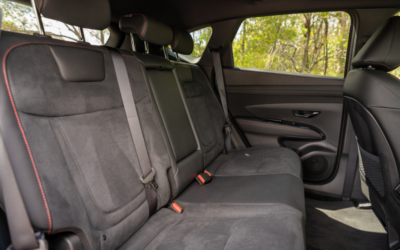
One of the most impressive parts of the Hyundai Tucson’s interior is the rear seat space.
There is legroom for taller people, plenty of elbow room and enough headroom to accommodate teenage basketball centres.
Add in plenty of storage space throughout the cabin, a big boot, USB points front and rear and those adjustable rear air-con vents and you can see there’s been plenty of attention paid to details.
You’ll find the front seats are also comfortable and welcoming in their size and adjustability. The bench seat in the rear does not slide fore-aft. The Tucson is strictly a five-seater without a third row option, unlike some rivals.
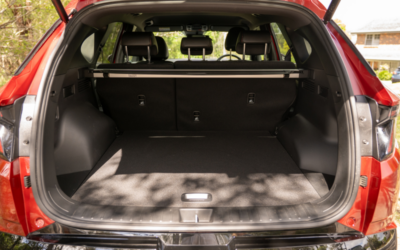
Boot space is 539 litres expanding to 1860 litres in the 2.0 and 582 litres expanding to 1903 litres in the hybrid. The latter gets more room because it has a space saver rather than full size spare tyre.
Slightly less space and a full size spare tyre would be preferable, thanks!
The screens mean there’s plenty of dabbing when searching for functions, but thankfully there are still hard buttons for items such as air-con and audio adjustment.
The Tucson is built in Korea and through our sampling of various models we’ve encountered no notable quality issues.
Powertrain and Dynamics
There is quite a gulf in performance between the two engines offered with the Hyundai Tucson.
While it’s $4500 cheaper up-front, the 2.0 is no great shakes when it comes to response. Its lack of pulling power means the six-speed auto spends plenty of time gear-shifting when it comes time to tackle hills or overtake.
From our experience that acceleration effort also brings with it higher fuel consumption than the 8.1L/100km claim.
The hybrid, with its e-motor – fed by a small battery – provides smooth tip-in acceleration and a substantial supplement to the small petrol engine is stronger and more economic.
So, it’s the long-term play, if you have the money to think ahead (resale values have been solid on hybrid models, too).
The Tucson is a solid but uninspiring drive. Hyundai used to tune suspension and steering for local roads but abandoned that a few years ago. The Tucson is still decent, but it just doesn’t feel as smooth and assured on our poor roads as, say, the Sportage from sister brand Kia, which does get local tuning.
Unlike some hybrid all-wheel drive medium SUVs such as the RAV4 that add an e-motor to the rear axle, the Tucson retains a mechanical link. This adds weight and fuel consumption and as a drive the AWD hybrid feels less convincing than the FWD.
Adding AWD hardly makes it an off-roader either. The Tucson is a gravel-roader and that’s about its limit.
Basically, the front-wheel drive hybrid is the sweet spot.
2025 Hyundai Tucson Verdict
The Hyundai Tucson is a convincing entry in the medium family-oriented SUV segment.
It does most things right, very little wrong, and while it lacks a bit of inspiration, it ticks the right boxes and should be on your consideration list.
Rating: 7.5/10
Your Ideal Hyundai Tucson Is Just a Click Away
Let Motor Scout do the hard work so you can easily drive away in the Tucson that suits your lifestyle.
2025 Hyundai Tucson Specifications
Model variants: Tucson, Elite, Premium (plus N Line packs for Elite and Premium).
Price: $38,350 to $59,850 plus on-road costs.
Engine/drivetrain options: 2.0-litre six-speed auto, front-wheel drive; 1.6-litre petrol-electric hybrid, six-speed auto, front- or all-wheel drive.
Power/torque: 115kW/194Nm 2.0-litre petrol four-cylinder; 172kW/367Nm 1.6-litre petrol-electric hybrid.
Fuel consumption: 8.1L/100km 2.0; 5.2L/100km hybrid.
Main Rivals
The Hyundai Tucson sits in one of Australia’s most competitive vehicle segments, so it naturally goes up against several strong medium SUV contenders. Here’s why these models are considered its key rivals:
- Toyota RAV4 – Competes directly as one of the best-selling medium SUVs with hybrid options.
- Kia Sportage – Shares the same size, features and pricing, appealing to the same family SUV buyers.
- Nissan X-Trail – Another spacious, practical medium SUV with similar capability and positioning.
- Mazda CX-5 – Known for strong quality and comfort in the same mid-size SUV segment.
- Honda CR-V – A reliable, family-focused medium SUV targeting similar shoppers.
- GWM Haval H6 – Cheaper Chinese alternative offering similar size and value features.
- MG HS – Budget-friendly medium SUV that competes heavily on price.
- Chery Tiggo 7 – Another value-driven mid-size SUV appealing to cost-focused buyers.