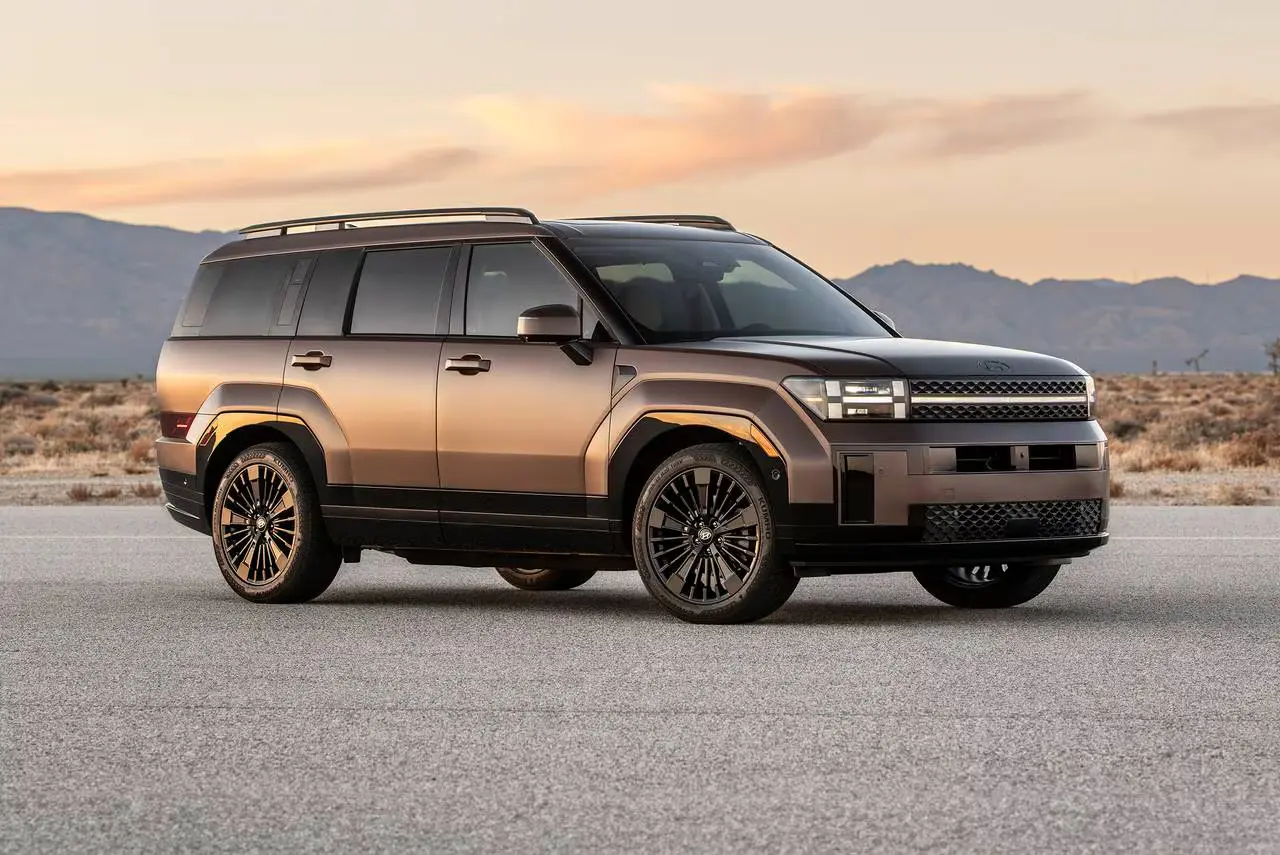
The fifth-generation 2025 Hyundai Santa Fe lands in Australia with the swagger of a boxy concept car and the sensibility of a school-run veteran. Extended wheelbase, squared-off styling, and a hybrid-first launch strategy show Hyundai has aimed this seven-seater at active families who still like a bit of design theatre. Under the skin you choose between a thrifty 1.6-litre turbo-hybrid (172 kW/367 Nm, 5.6 L/100 km combined) or a stronger 2.5-litre turbo-petrol (206 kW/422 Nm, 9.3 L/100 km) that joined the range this year. Prices now start at $53,000 and top out near $77,000 before on-road costs, giving the Santa Fe a price ladder long enough for most budgets.
Pros and Cons
Pros
- Spacious, lounge-like cabin with dual 12.3-inch displays
- Hybrid drinks like a small hatch (5.6 L/100 km)
- Standard Hyundai SmartSense safety suite: 10 airbags, junction AEB, Level 2 lane-centred assist
Cons
- Dual-clutch auto in petrol can stumble at car-park speeds
- Light-coloured trims mark easily when kids attack
- Boxy styling wins fans but not everyone
How Much Does It Cost?
Australian pricing for the 2025 Hyundai Santa Fe opens at roughly $53,000 before on-road costs for the base 2.5-litre turbo-petrol, climbs to about $60,000 for the entry 2025 Hyundai Santa Fe Hybrid, and peaks just under $77,000 for the fully loaded Calligraphy Hybrid AWD, or around $84,000 drive-away once state charges are added. The three-tier line-up: Base, Elite, Calligraphy, simply layers on more kit as you move up, so items like Bose audio, larger wheels, ambient lighting and plush Nappa leather appear in logical steps, letting buyers match budget to indulgence without tackling tangled option packs.
Features and Benefits
Even the Base brings wireless Apple CarPlay/Android Auto, a panoramic curved display, full-size spare, and remote-start digital key. Elite steps up to 12-speaker Bose audio and heated wheel, while Calligraphy adds ventilated captain’s chairs and a head-up display. The 2025 Hyundai Santa Fe features list reads like a luxury SUV brochure, yet it still undercuts many rivals by five grand.
Safety
All variants score a five-star ANCAP rating thanks to ten airbags, junction-turning AEB, adaptive cruise with stop-and-go, and a surround-view monitor. Hyundai’s SmartSense suite now includes remote parking assist, so you can step out and watch the big Hyundai shimmy into tight spaces.
Running Costs
Service intervals are 12 months/15,000 km with Hyundai’s Lifetime Capped-Price plan; the first five visits average about $399 each. Fuel bills depend on your choice of powertrain: the 2025 Hyundai Santa Fe Hybrid claims 5.6 L/100 km while the petrol sits at 9.3 L/100 km. Both powertrains accept 91-RON unleaded, and a five-year/unlimited-kilometre warranty (eight years on the hybrid battery) rounds out ownership peace of mind.
Comparison To Its Competitors
Compared with its closest seven-seat hybrids, the new Santa Fe cuts a sharp deal. Kia’s Sorento Hybrid GT-Line lists at about $81,000, with the plug-in version nudging $84,660, and posts roughly 5.7 L/100 km on the ADR test. Toyota’s perennial Kluger Hybrid starts at $60,920 and climbs to $83,535 while matching Hyundai’s claimed 5.6 L/100 km. Mazda’s fresh CX-80 PHEV spreads from $54,950 to beyond $92,000 and touts a headline 2.7 L/100 km lab figure when fully charged. Slotting between $53,000 and $77,000, the Santa Fe undercuts Kia, shadows Toyota at entry level, and stays well clear of Mazda’s upper ceiling, yet still matches the Kluger on efficiency without the cost or complexity of a plug-in system.
2025 HYUNDAI Santa Fe: Practicality Meets Performance
Conclusion
The 2025 Hyundai Santa Fe hits a sweet spot in the large-SUV maze. It looks like a concept car escaped onto the school run, yet it backs the look with family-focused cleverness and the option of a genuinely economical hybrid. A smoother gearbox in the petrol and darker kid-friendly trims would edge it closer to perfection, but Hyundai’s big box of tricks is already hard to ignore.
Rating: 8.6/10
Brilliant space, serious tech and the Hyundai Santa Fe’s hybrid efficiency earn big ticks. Minor transmission foibles and a few interior-practicality niggles keep it from a 9, yet for families who want style without sacrificing substance, Hyundai’s Santa Fe is bang on target.